Author Archives: k6aq

FreeDV at HamCation 2026

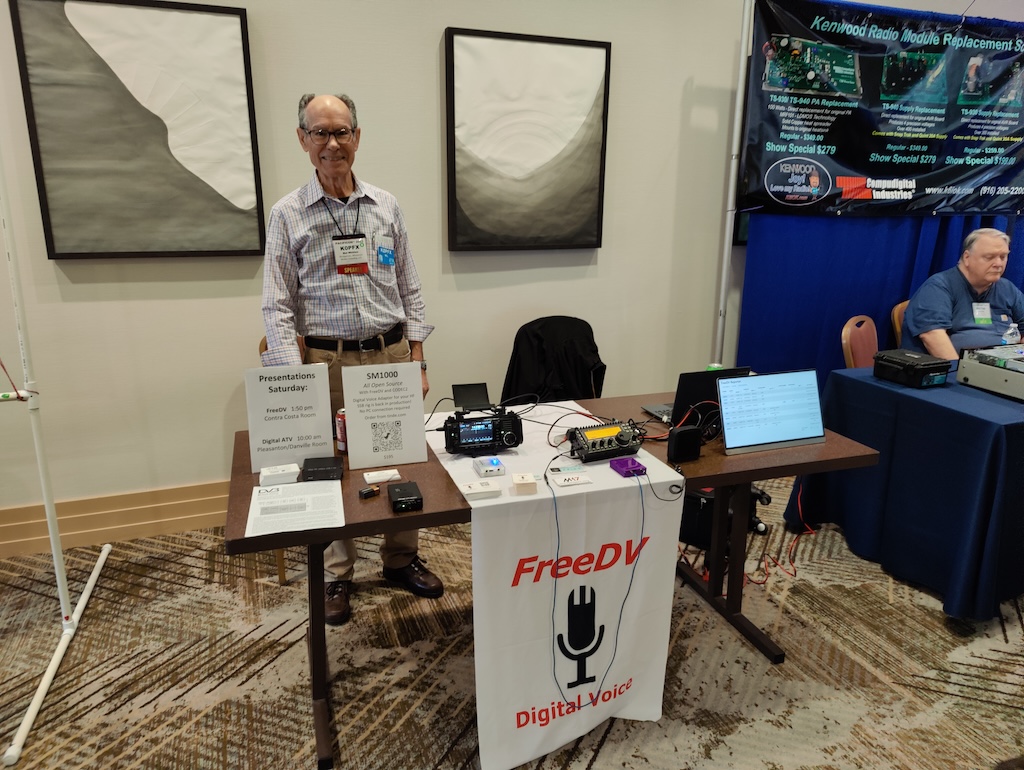
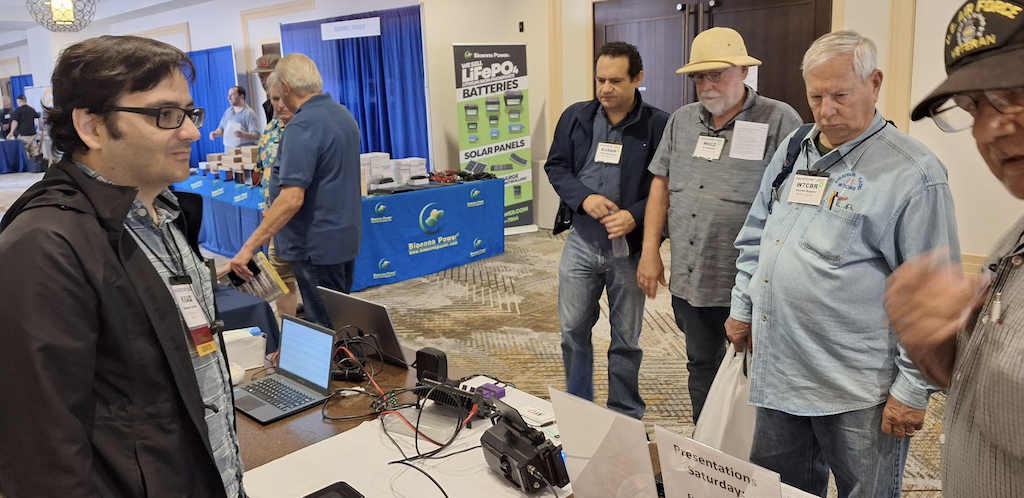
We just returned from another successful HamCation 2026. Our booth was located in the North Hall, across from the hamfest’s prize booth:

oplus_3145728
oplus_3145728
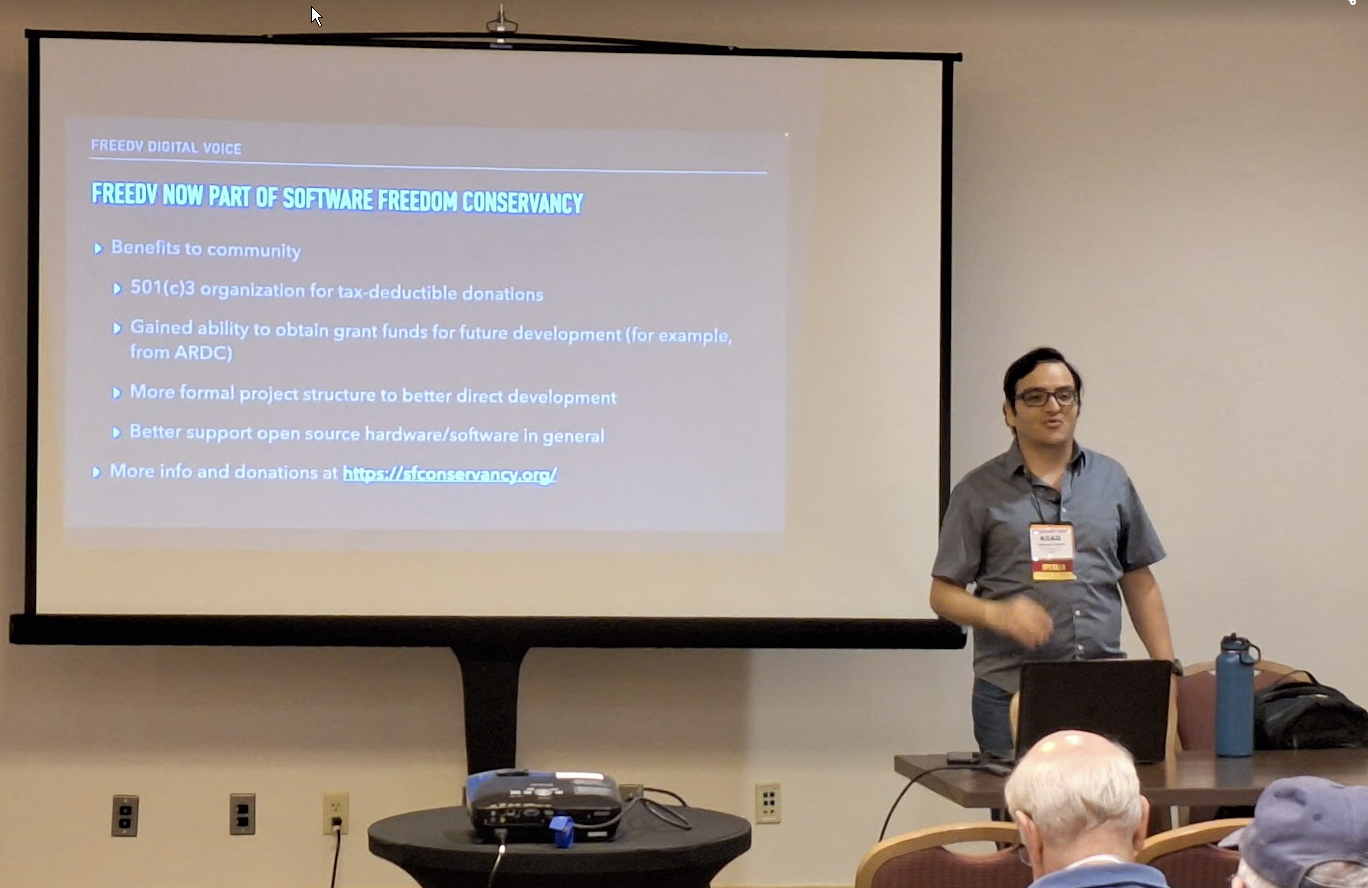
oplus_3145728

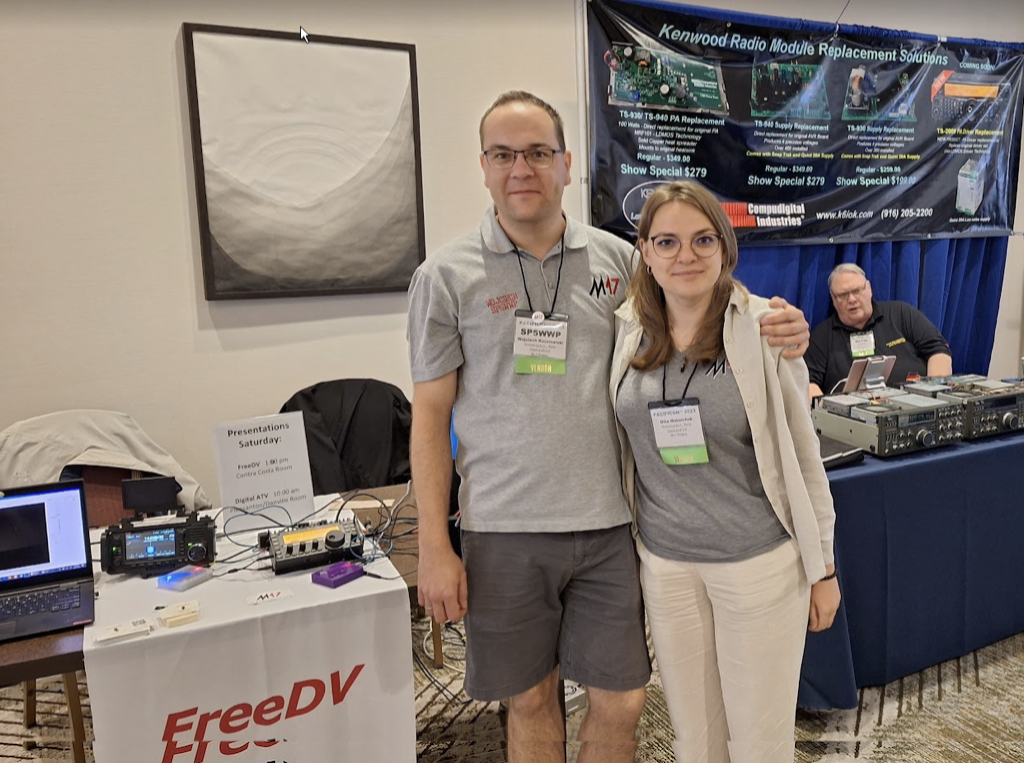
During the hamfest weekend, FreeDV team members Mooneer Salem (K6AQ), Mel Whitten (K0PFX) and Walter Holmes (K5WH) answered questions from current and prospective FreeDV users and demonstrated the audio quality of FreeDV’s RADE mode and integration with radios manufactured by FlexRadio. In particular, Mooneer and Walter connected to their home stations (Mooneer using an iPad and Walter using a laptop) and demonstrated how the FlexRadio AppImage running on a Raspberry Pi can create a FreeDV “mode” inside the SmartSDR software and effectively make FreeDV operation the same as operating analog sideband.

Additionally, Mooneer gave a talk about how to set up FreeDV, which was graciously recorded by WG7D:

Hope to see you next year!

EDIT: Added missed image of Walter, Mel and Mooneer in the booth.

FreeDV 2.2.1 released

FreeDV 2.2.1 has been released, containing bugfixes for issues discovered since the release of 2.2.0 along with a change to ensure continued operation of the FlexRadio integration. It can be downloaded using the following links:

More information about this release can be found on GitHub release page.

Mooneer’s FreeDV Update – January 2026

During the month of January, a lot of work was done on the FlexRadio integration. This consisted of adding some features to the AppImage that were desired by the users testing it, such as:

  • Enabling the SO_REUSEADDR socket flag on the discovery socket so that the waveform doesn’t interfere with other applications running on the user’s Raspberry Pi (such as NodeRed)
  • Allowing Ctrl-C to be used to exit the waveform
  • Additional command line arguments to provide a reporting message to FreeDV Reporter, adjust audio volume, and perform other configuration

For the main FreeDV application, additional functionality was also implemented around the FreeDV Reporter window, such as being able to right-click on callsigns and perform lookups and having a more visible indication that the idle filter is enabled. Once these features were added, an additional several weeks were taken to fix bugs discovered during testing before version 2.2.0 was finally released near the end of the month.

During this coming month (February), I’ll be preparing for travel to Orlando HamCation, where I will again be giving a talk about FreeDV as well as manning the FreeDV booth. Hope to see you there!

More information can be found in the commit history below:

(Note that all commit logs above were generated with the following command line:)

git log --author="member@email" --after "Month 1, 2026" --before "Month 31, 2026 23:59:59" --all

FreeDV 2.2.0 released

FreeDV 2.2.0 has been released, containing bugfixes and feature enhancements, including integration with logging software and enhancements to the previously released FlexRadio integration. It can be downloaded using the following links:

More information about this release can be found on GitHub release page.

Mooneer’s FreeDV Update – December 2025

Happy (late) New Year!

This past month, I was able to get the performance improvements for the RADE bandpass filter merged into the RADE repo. These improvements cut the amount of time needed to perform the bandpass filtering by half, as well as reducing memory allocations (thus reducing the likelihood that decode stalls due to the operating system needing to allocate more memory to the application).

As for the main FreeDV application, significant progress was made towards implementing the features previously approved by the PLT. The biggest of these features is integration with various logging tools. For this integration, it was decided to use the mechanism that WSJT-X has (namely sending UDP packets in a specific format that the logging tool can parse and act on them accordingly). In testing with various loggers that support the WSJT-X network protocol (KLog for example), this seems to work pretty well.

Another major FreeDV application improvement is the addition of an “idle” filter to the FreeDV Reporter window. That is, when enabled, it will hide users that haven’t updated themselves (either by transmitting or otherwise) after a given number of minutes. This is useful for users running nets as the people who are most recently active will be more likely to be net participants.

I also fixed many bugs discovered since version 2.1.0 was released, including with the Flex waveform and the Web version of FreeDV Reporter. Thanks to everyone who’s reported these bugs as this gets us closer to a bug-free experience for everyone 🙂

More information can be found in the commit history below:

(Note that all commit logs above were generated with the following command line:)

git log --author="member@email" --after "Month 1, 2025" --before "Month 31, 2025 23:59:59" --all

Mooneer’s FreeDV Update – November 2025

This month was fairly light on work due to the Thanksgiving holiday here in the US. However, a few things did get done:

  • FreeDV 2.1.0 was released. This contained numerous bugfixes as well as the initial release of FlexRadio integration (in the form of an AppImage that can be run on a newer Raspberry Pi). In the future, an update to SmartSDR will allow this integration to be uploaded to an 8000 or Aurora series radio, avoiding the need for an external hardware device. As this shares a lot of code with the regular FreeDV application, versioning of the Flex waveform will follow the main application’s.
  • FreeDV Reporter reliability was improved as well, to the point where combined with version 2.1.0, it now remains stable through the weekly US FreeDV net on 40 meters. Previously, the server would stop responding due to the sheer amount of traffic/users.
  • Work continues on performance improvements in the Python code underpinning the RADE mode. Right now, we are determining what components will be shared with RADEV2 and prioritizing those changes over others that may be thrown out later.

As for this coming month, it may also be a light month due to the Christmas holiday but the hope is to implement some additional features for the upcoming version 2.2 release. We’ll see how that goes in any case.

More information can be found in the commit history below:

(Note that all commit logs above were generated with the following command line:)

git log --author="member@email" --after "Month 1, 2025" --before "Month 31, 2025 23:59:59" --all

FreeDV v.2.1.0 released

FreeDV 2.1.0 has been released, containing bugfixes and feature enhancements, including experimental support for integrating FreeDV with SmartSDR (for Flex 6000, 8000 and Aurora series radios). It can be downloaded using the following links:

More information about this release (including additional downloads) can be found on our GitHub release page.

Mooneer’s FreeDV Update – October 2025

As with David, a large amount of my time was spent at Pacificon talking to people interested in FreeDV (whether at the booth or during the talk I gave on Saturday morning. Thank you once again for coming out!

When I wasn’t at Pacificon, however, I did get a fair bit done on the rig integration front. Along with the integration for the Flex 8000 and Aurora series, there’s also a new receive-only integration available that’s intended for web-based SDRs. Originally intended for ka9q-radio, this is an application that accepts audio samples on standard input and outputs decoded audio on standard output. An SDR or other application would simply start this application and route audio through it whenever a user wants to decode FreeDV. The hope is that with this integration, many preexisting web-based SDRs will add support for FreeDV and allow people to listen to contacts over the internet, even if they don’t have a radio or the needed setup to run the FreeDV application.

I was able to also use the existing work that has been done for the Flex waveform to begin generating new AppImages as well. Our CI process now generates the following Linux builds:

  • aarch64 AppImage (KA9Q and FlexRadio integrations, main FreeDV application): Intended for e.g. Raspberry Pi.
  • x86_64 AppImage (KA9Q integration, main FreeDV application): For Intel and AMD-based machines.
  • FlexRadio Docker/podman container for aarch64: Intended for eventual upload directly to the Flex 8000 and Aurora series radios. This is able to be run on a Raspberry Pi 4 and later; SmartSDR does not support uploading this to the radio yet.

Speaking of the main FreeDV application, the recent work on BBWENet was also integrated into the audio pipeline. BBWENet is basically a machine learning method to extend speech at 16 kHz sample rate to 48 kHz by reconstructing what was dropped during the transmit process. This is currently experimental, but as it does not seem to negatively affect receive audio quality, it’s enabled by default in the most recent FreeDV builds (i.e. if you run the “master” branch from our Git repository).

There was also a fairly nasty bug involving the receiver intermittently no longer decoding any signals. It turns out that this was a bug in the RADE Python code where the number of expected input samples wasn’t being reset when losing sync. If there are a lot of changes in sample clocking combined with audio dropouts over a long enough period of time, this easily duplicates the problem. This is also now in the “main” branch of the RADE repo and will be in the next version of FreeDV.

Finally, due to the recent dramatic increase in FreeDV users, FreeDV Reporter is beginning to show signs of not being able to keep up. I checked in a change to the server as a temporary measure but we will need to come up with something more permanent soon (in fact, there was an extended outage just yesterday as of this writing, so that will probably come sooner than I expected).

More information can be found in the commit history below:

(Note that all commit logs above were generated with the following command line:)

git log --author="member@email" --after "Month 1, 2025" --before "Month 31, 2025 23:59:59" --all

FreeDV at Pacificon 2025

FreeDV had a booth at Pacificon over in San Ramon, CA from October 10-12, where many Hams showed interest in FreeDV and our flagship RADE mode. In addition to the booth, both Mooneer and David gave talks to a packed, standing room only audience with many questions being asked about FreeDV and RADE.

We also had the opportunity to talk to many leaders of the Ham community, including Jim McLaughlin (MMDVM) around RADE-BBFM collaboration, Phil Karn (ARDC) who is very enthusiastic about RADE and it’s game changing impact on HF speech, Bruce Perens (post open) and Steve Stroh (zero retries newsletter).